
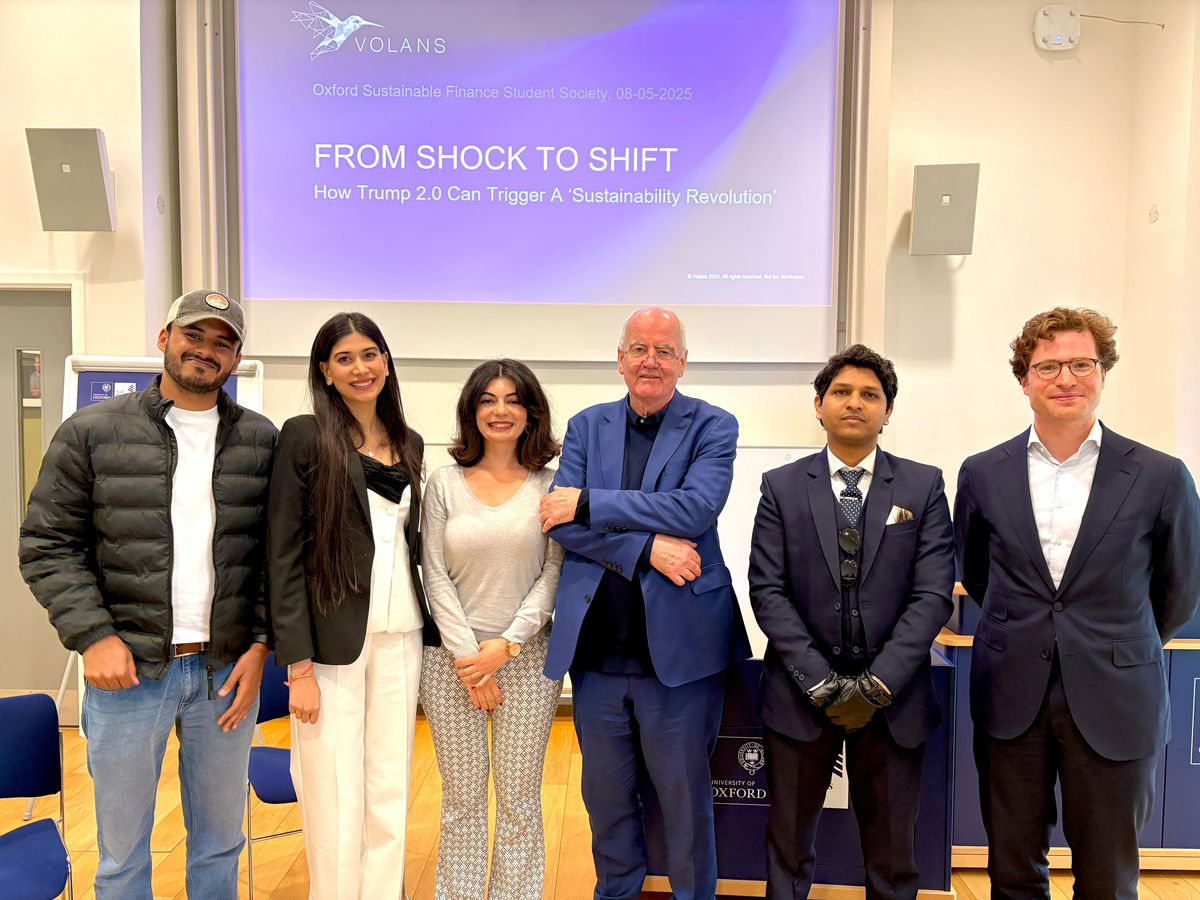
At the start of Trinity Term, the Oxford Sustainable Finance Student Society hosted John Elkington for a session titled "From Shock to Shift: How Trump 2.0 Can Trigger a Sustainability Revolution," moderated by Professor Thom Wetzer of the Oxford Sustainable Law Programme. The event examined how political upheaval might create opportunities for breakthrough sustainability reforms.
The Polycrisis and the ESG Recession
Elkington opened by highlighting global disruptions including floods in Puerto Alegre and the Indus region, describing the current state as a "polycrisis"—a convergence of environmental, political, and economic stresses. He warned of an emerging sustainability recession driven by ESG pushback, climate inaction, and corporate retreat.
He noted that turbulent periods often reveal new opportunities, citing China's swift advancement in solar energy, battery storage, and AI technologies amid global uncertainty.
Green Swans and the X-Curve
Central to Elkington's argument was the concept of "Green Swans"—positive, exponential shifts catalyzed by crises representing radical reimaginings of market and institutional function. He explained the transition from traditional S-curves to X-curves enables faster sustainability transitions. Norway exemplified this transformation: in 2023, 82% of new car sales were electric, resulting from long-term policy alignment, public awareness, and technological readiness.
Market Redesign and Systems Thinking
Elkington advocated for market redesign prioritizing system value, where businesses holistically address social and environmental needs. He emphasized that true sustainability requires embedding these principles in market DNA rather than treating them as add-ons. He concluded by advocating for "Beaver Market" mindsets—industrious, adaptive, and catalytic.
Fireside Chat with Professor Thom Wetzer
Elkington and Wetzer discussed differences between ESG metrics and broader sustainability thinking, highlighting the necessity for systemic transformation over compliance-driven frameworks. They explored universities' emerging role in sustainability leadership and examined international cooperation, particularly China's integrated ecological strategy. The session concluded with cautious optimism that the coming decade may offer unprecedented opportunities for sustainable change.