
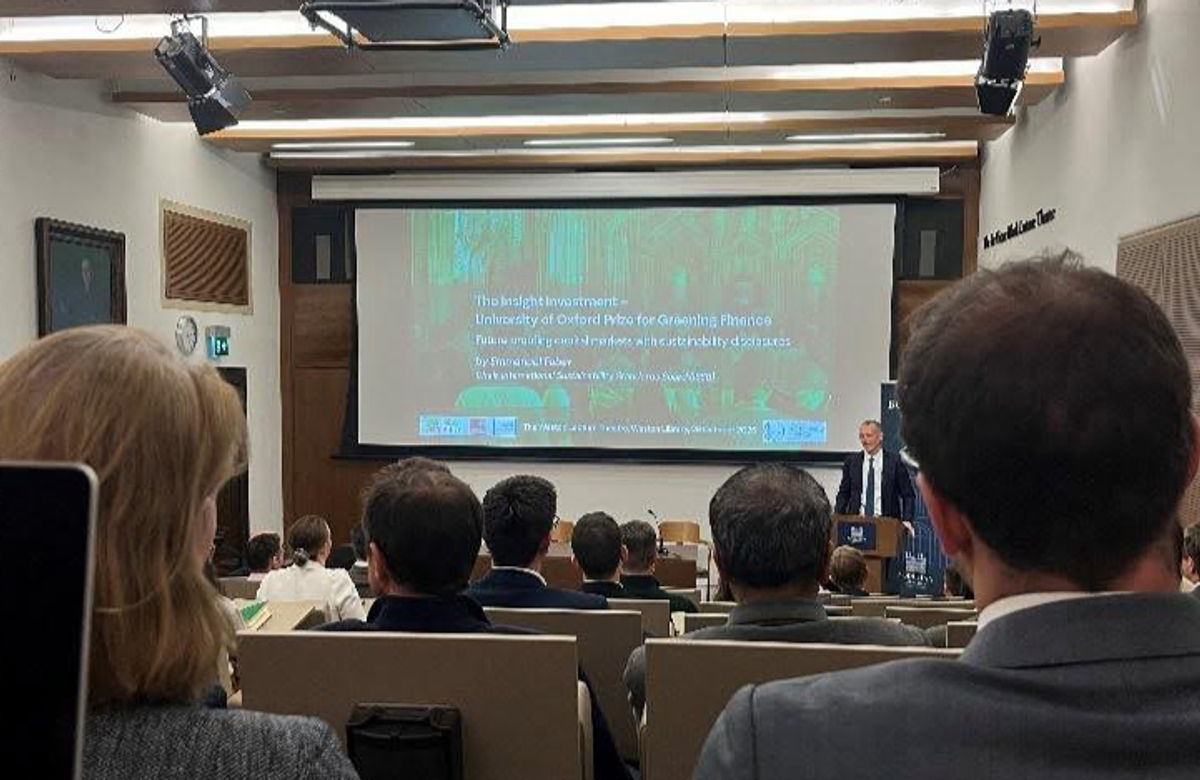
On October 29, the OSFSS committee attended a lecture by Emmanuel Faber, Chair of the International Sustainability Standards Board (ISSB), hosted by the University of Oxford and the Smith School of Enterprise and the Environment. The event recognized Faber's receipt of the University of Oxford Prize for Greening Finance, honoring his contributions at the ISSB and his prior work as CEO of Danone.
The 32-Year Problem: Why Traditional Accounting Fails
Faber highlighted a significant disconnect in capital markets. He noted the average "market-to-book value ratio is 5x," indicating that 80% of a company's perceived value remains unreported on balance sheets.
With S&P 500 price-to-earnings ratios at 32x, investors essentially price in 32 years of future earnings. Faber contended that conventional financial reporting cannot adequately forecast value so far ahead, particularly when valuations depend primarily on one variable: "g" (perpetual growth).
A Global Baseline: The ISSB's Solution
Faber described the ISSB's objective: establishing "generally accepted principles for the accounting of risks and opportunities."
- IFRS S1 (General Requirements) and IFRS S2 (Climate) establish a comprehensive worldwide standard requiring companies to disclose material sustainability-related risks and opportunities.
- The standards remain "policy-neutral." Faber emphasized the intent is not prescribing environmental definitions but rather offering consistent language enabling investors to "price resilience" and risk more accurately, citing examples like Rhine River water levels and nuclear plant cooling requirements.
From Theory to Global Adoption
Faber emphasized accelerating momentum, with "40 jurisdictions" representing 60% of global GDP already adopting these standards. This encompasses numerous Global South nations seeking to attract foreign investment and develop capacity.
Geopolitical tensions amplify sustainability dangers, making such standards increasingly necessary rather than optional.
Key Challenges from the Floor
Audience discussion encompassed practical concerns regarding complex scenario modeling, equitable Global South adoption without imposing barriers, and ensuring sustainability reporting integrates into primary financial systems rather than remaining compartmentalized within corporate social responsibility documents.
Following the reception, attendees continued conversations during a formal dinner in Oxford's historic Divinity School.