
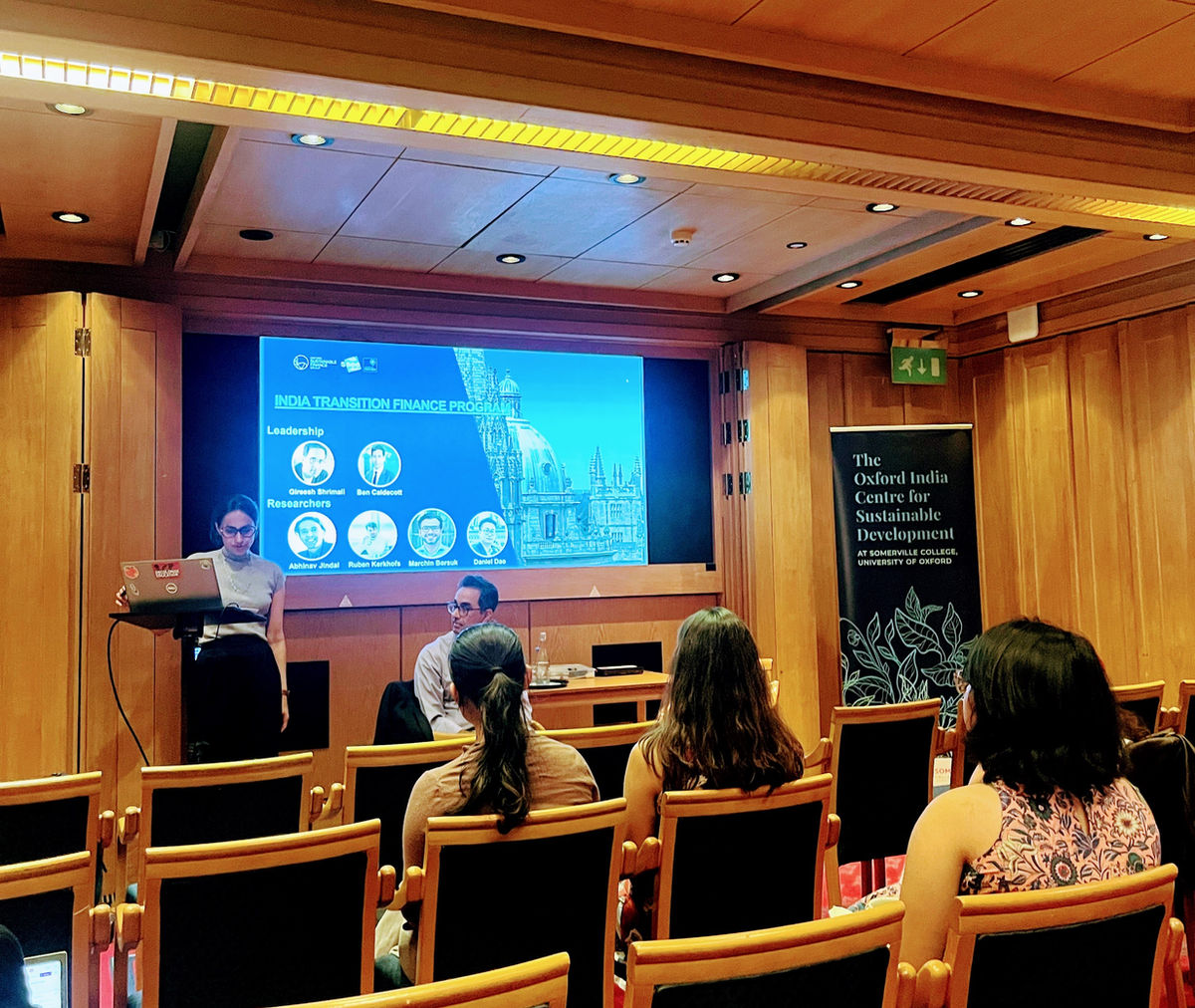
The Oxford Sustainable Finance Student Society, alongside the Oxford Climate Society and Oxford India Centre for Sustainable Development, hosted a presentation on the India Transition Finance Program (ITFP). Led by Dr. Gireesh Shrimali, Head of Transition Finance Research at the Oxford Sustainable Finance Group, the session explored how India can transition to a low-carbon economy while addressing physical and transition risks.
The Oxford Sustainable Finance Ecosystem
The Oxford Sustainable Finance Group operates across three interconnected pillars:
- Research & Analysis: Developing methodologies for climate risk assessment and transition planning
- Education & Training: Building capacity within financial institutions and regulatory bodies
- The Lab: Creating practical tools and frameworks for industry application
The group specializes in Transition Finance, including Environmental Stress Testing and Scenarios (ESTS), Net Zero Transition Plans (NZTP), Energy Transition Risk and Cost of Capital (ETRC), and the India Transition Finance Program.
Why India? A Perfect Storm of Climate Risks and Opportunities
Physical Risk: Climate Vulnerability at Scale
India faces extraordinary exposure to physical climate risks. The nation has committed to achieving net zero emissions by 2070, with transition costs estimated at US$10–19 trillion. Critical factors include:
- India ranks among the "top five countries globally most exposed to rising temperatures, with projections showing potential increases of up to 5°C by 2100"
- Extreme weather events—heatwaves, floods, and droughts—have escalated dramatically
- Economic losses from climate change could reach 3-10% of GDP by 2100
Transition Risk: The World's Third-Largest Emitter
India accounts for approximately 7% of global greenhouse gas emissions. However, its cumulative historical emissions represent only 3.2% of the global total, and per capita emissions remain at 40% of the global average. As industrialization accelerates, India's emissions trajectory becomes critical for global climate goals.
Regulatory Evolution: Building the Framework
The regulatory landscape is evolving across multiple fronts:
- Reserve Bank of India (RBI): Draft guidelines requiring TCFD-style climate risk disclosures across governance, strategy, risk management, and metrics
- Securities and Exchange Board of India (SEBI): Mandating climate risk disclosures in Business Responsibility and Sustainability Reports (BRSR) for top listed companies
- National Climate Commitments: Net-zero by 2070 with interim 2030 targets including 45% emissions intensity reduction and 50% non-fossil electricity generation
- Carbon Market Development: In 2022, the Indian government amended the Energy Conservation Act, empowering establishment of a domestic carbon market (likely starting mid-2026)
Research Findings: Quantifying Transition Risk in India's Power Sector
Differentiated Impact Analysis
The ITFP research revealed striking variations in how climate transition affects different energy subsectors:
- Fossil Fuel Companies: Substantial losses of up to 100%
- Renewable Energy: Moderate gains of less than 50%
- Hydropower: Minimal impact due to its established low-carbon profile
- Nuclear Energy: Mixed outcomes depending on policy frameworks and technological developments
Cash Flow at Risk (CFaR) Analysis
Researchers developed detailed Excel models to quantify transition risk for six leading Indian power companies. The analysis reveals the "Indian power sector faces an average loss of nearly 50% due to the higher concentration of fossil fuel assets relative to renewable capacity."
The Importance of Policy Timing
A crucial finding emphasized that early policy action significantly reduces transition losses. Implementing climate policies five years earlier could reduce losses for coal companies by up to 50%, highlighting the importance of proactive rather than reactive policy frameworks.
Physical Risk: Beyond the Obvious
Portfolio-Level Tail Risk Analysis
Using Monte Carlo simulations, the research team quantified how extreme climate events translate into financial risks for power sector portfolios:
- Spatial Correlation Matters: Different assumptions about how flood impacts correlate geographically can lead to significant underestimation of results—up to 200% in some scenarios
- Geographic Diversification Benefits: Indian power assets' geographic dispersion provides natural risk reduction for diversified portfolios
- Insurance as Risk Mitigation: Value at Risk increases significantly (up to 100%) in the absence of proper insurance coverage
The Financing Gap: Scale Meets Reality
According to the "Landscape of Green Finance in India" by CPI, India requires INR 162.5 trillion (USD 2.5 trillion) by 2030 to meet its Nationally Determined Contributions. However, tracked green finance flows cover only approximately one-third of this requirement. India currently achieves less than half the annual investment required for its climate transition, representing a significant USD 10 trillion funding gap.
Cost of Capital: The Hidden Challenge
Understanding cost of capital emerged as a critical factor in India's transition finance landscape. The research emphasized that low-carbon transitions are "extremely sensitive to the cost of capital," making it essential to understand what drives costs for green technologies, how different risk components affect borrowing costs, and what policy interventions can reduce capital costs for clean energy projects.
Looking Forward: Research Priorities and Policy Implications
Immediate Research Focus
ITFP has ambitious plans for future research:
Climate Risk (In Progress):
- Risk propagation through supply chains and financial networks
- Top-down macro stress testing frameworks
Transition Plans (Planned):
- Disclosure frameworks and credibility assessments
- Transition finance mechanisms similar to ongoing research in Thailand
Cost of Capital Analysis (Just Starting):
- Risk premia decomposition and solutions for addressing component risks
- Enabling finance for transitioning to a low-carbon future
Policy and Investment Implications
The research raised several critical questions:
- Risk Distribution: As one attendee noted, the question becomes who bears the stranded asset risks, often resulting in taxpayers funding and bearing these risks
- Voluntary Disclosure Challenges: Companies performing well on climate metrics want to disclose progress, while poor performers avoid disclosure—creating an adverse selection problem
- The Role of Development Finance: Leverage and debt financing may not be optimal tools for development finance institutions to deploy capital in transition finance
Key Takeaways for Sustainable Finance Practitioners
- Measurement Drives Management: Quantifying climate risks enables better risk management and more informed capital allocation decisions
- Timing Is Critical: Early policy intervention dramatically reduces transition costs and risks
- Diversification Benefits: Geographic and technological diversification can significantly reduce portfolio-level climate risks
- Insurance Infrastructure: Developing robust insurance markets is essential for managing physical climate risks
- Integrated Approach Needed: Successful climate finance requires coordination between central banks, securities regulators, and development finance institutions
Conclusion
The India Transition Finance Program represents more than academic research—it provides a roadmap for one of the world's largest economies to navigate the complex intersection of development needs, climate vulnerability, and financial stability. As India's draft Climate Finance Taxonomy aims to guide green investments, prevent greenwashing, and support its net zero target, the insights from Oxford's research will prove invaluable for policymakers, investors, and financial institutions globally.
For the sustainable finance community, India's transition offers both an opportunity to test new methodologies and a preview of challenges that other emerging economies will face. The work of the Oxford Sustainable Finance Group provides essential tools and frameworks for navigating this complex landscape successfully.